
'Nuclear safety evaluations are being put in the public domain to enhance transparency and boost public confidence,' the prime minister told the second Nuclear Security Summit. Nikhil Lakshman reports from Seoul

Chinese President Xi Jinping warned US President Donald Trump that mishandling the Taiwan issue could trigger conflicts between the two countries during wide-ranging talks on trade, Iran, and energy security.

This sharp Iranian response came after a series of uncompromising remarks from the US president.

Amidst global energy market volatility driven by the West Asia crisis, Russia has proposed increasing its crude oil and natural gas supplies to India, strengthening bilateral energy ties and aiming for USD 100 billion in annual trade by 2030.
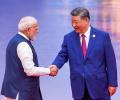
For India, China's Indian Ocean power projection, maritime domain awareness, dual-use ports, underwater surveillance, antisubmarinewarfare, naval exercises with Pakistan, pose considerable pressure, depleted India's strategic depth and marginalises Indian role, points out Srikanth Kondapalli.

US President Barack Obama and Prime Minister Manmohan Singh will meet in Washington on Sunday, during which the two leaders will discuss the civil nuclear deal and other bilateral and regional issues.

US President Donald Trump is set to visit China for talks with President Xi Jinping on trade, global issues, and the Gulf war. The visit aims to address trade frictions and other key issues, with high expectations for progress.

US President Donald Trump received a red carpet welcome in Beijing for talks with Chinese President Xi Jinping on trade, the Iran war, and other key issues. The visit underscores the importance both nations place on their relationship amid ongoing tensions.

India and Canada are negotiating a long-term uranium supply agreement worth $2.8 billion. They are also exploring expanded civil nuclear cooperation after the passage of the SHANTI Bill.
'The Washington summit is as much about nonproliferation and arms control as about nuclear security,' says T P Sreenivasan.

The question is whether the clocks allow enough time for two deeply mistrustful sides to get there, and whether the surface calm holds long enough for the paddling to produce something before the ceasefire ends on April 22, notes Prem Panicker in his must read blog on the Iran War.

Kerry said Obama has called the relationship with India 'a defining relationship of this century'.
The death of bin Laden on May 2 last year has not removed or diluted the threat of jihadi terrorist organisations acquiring a nuclear capability, argues B Raman.
With Pakistan obviously on his mind, Prime Minister Manmohan Singh warned on Tuesday, of the dangers posed by nuclear explosives falling into the hands of non-state actors posing danger to India and other countries. Addressing the Nuclear Security Summit in Washington, he pitched for "zero tolerance" against individuals and groups which engage in illegal trafficking of atomic explosives and announced India's decision to set up a 'Global Centre for Nuclear Energy Partnership'.
Prime Minister Manmohan Singh's presence at the first-ever Nuclear Security Summit hosted by United States President Barack Obama, beginning April 12, will be key for 'critical substantive reasons', believes Dr Ashley J Tellis, an expert on nonproliferation and nuclear security matters.

During last week's Nuclear Security Summit, President Obama asked the media to leave and then screened videos depicting plausible scenarios pertaining to nuclear terrorism.
The US-hosted Nuclear Security Summit, to be attended by leaders of 40 countries including Prime Minister Manmohan Singh, is expected to issue a communique endorsing a global crackdown on illicit trade of nuclear material. A draft communique also calls for securing all vulnerable nuclear materials within 4 four years, The Wall Street Journal reported on Wednesday.

Obama seeks reduction of nuclear arsenal in India and Pakistan while Pakistan seeks NSG membership

The 'rescue' operation occurred within kilometres of Iran's underground tunnel complex at Isfahan, assessed by the IAEA and US intelligence as holding a substantial portion of the country's 60 per cent enriched uranium stockpile. Retired senior US military officers have highlighted that the mission's footprint -- hundreds of special operators, multiple heavy-lift aircraft deep inside Iran -- appears outsized for recovering a single airman. Prem Panicker continues his must read blog on the Iran War.

With the regulatory approval from the US Department of Energy in its kitty, Indian multinational conglomerate L&T is planning to focus on manufacturing small modular reactors (SMRs) to play a leading role in the commercialisation of nuclear energy in India.
Prime Minister Manmohan Singh is expected to raise pitch at the Nuclear Security Summit in Washington for strong commitments by individual countries and firm responses by international community against proliferation, amid fears about terrorists gaining access to atomic material.

Proliferation and potential use of nuclear weapons pose the most dangerous threat to global security and peace, US President Barack Obama has said.
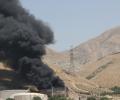
Asked about the expectations from the US, Azar said Washington and Israel are "completely in sync". He said he felt that the US would "support" Israel's action.
United States President Barack Obama on Tuesday warned that the threat of nuclear weapons remains a challenge as there are still "too many bad actors in search of these dangerous materials", asserting that the world's security depends on the actions that the global community takes.
"The Obama administration has favoured new international civil nuclear-energy architecture, an architecture that allows countries around the world to benefit from the peaceful uses of nuclear energy without increasing proliferation risks," said Robert J Einhorn, Special US Advisor for Nuclear Non-Proliferation and Arms Control.
Prime Minister Manmohan Singh on Saturday embarked on a visit to the United States to attend the Nuclear Security Summit, where he is expected to pitch for firm response to the challenges of proliferation and the possibility of terrorists gaining access to nuclear material. During the eight-day visit, Dr Singh will also travel to Brazil to attend the Brazil-Russia-India-China and India-Brazil-South Africa summits.

By all available indications, the White House drafted a face-saving note and handed it, ready-made, to Islamabad. Pakistani Prime Minister Shehbaz Sharif was supposed to then post it in the guise of a plea urging Trump to extend the deadline by two weeks 'to allow diplomacy to run its course'. Trump would then graciously accept Pakistan's 'request' and declare a ceasefire. Sharif dutifully posted the message on X. Except that he, or whoever was handling the account, forgot to delete the tell-tale first line visible in the edit history: 'Draft - Pakistan's PM Message on X'. Prem Panicker's must read blog on the Iran War.
Diplomatic observers and South Asia experts in the US do not believe that two of India's major concerns that Prime Minister Dr Manmohan Singh brought up with President Obama on Afghanistan, during his state visit in November and again recently on the sidelines of the Nuclear Security Summit have been alleviated during the summit between Obama and Afghan President Hamid Karzai.
Russian President Vladimir Putin supervised strategic nuclear forces drills amid uncertainty surrounding a potential summit with US President Donald Trump to address the Ukraine conflict.

Putin's State visit will centre on fixing the huge India-Russia trade imbalance, with both sides pushing to lower duties, ease non-tariff barriers, and seal a landmark mobility pact to send more Indian workers to Russia.
US President Barack Obama vowed to secure all the vulnerable nuclear material around the globe in four years; as terrorist groups like Al Qaeda are aiming at getting a hand on them. "At April's Nuclear Security Summit, we will bring forty-four nations together behind a clear goal: securing all vulnerable nuclear materials around the world in four years, so that they never fall into the hands of terrorists," Obama said in his State of the Union Address.
Ahead of his two-nation visit beginning on Saturday, Prime Minister Manmohan Singh on Friday met President Pratibha Patil and discussed various issues, including internal security and Indo-Pak matters. A Rashtrapati Bhavan spokesperson said the meeting lasted for nearly an hour. "The two leaders discussed the upcoming session of Parliament, and the forthcoming visit of the prime minister to Washington for the Nuclear Security Summit," said a press release.
The second Nuclear Security Summit opens in Seoul on Monday. Will it confront the dangers posed by Pakistan's unsecured nuclear programme, asks Nikhil Lakshman, currently in the South Korean capital.
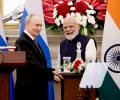
India and Russia have solidified a five-year plan to enhance their economic and trade partnership, while also addressing the ongoing conflict in Ukraine and the threat of terrorism.
US President Barack Obama would meet Prime Minister Manmohan Singh on the sidelines of the G-20 Summit in Toronto, a top Indian official said Wednesday. "The Prime Minister would be traveling for the G-20, he will be meeting President Obama," Union Minister of Commerce and Industry Anand Sharma told Indian media-persons in Washington.
Pakistan, which was a "major source" of nuclear proliferation in the past, has been invited to the US-hosted Nuclear Security Summit, as America wants it to be part of the solution to the problem, a top Obama Administration official said on Saturday.
At the Nuclear Security Summit in Seoul the focus is on countering nuclear terrorism, strengthening nuclear security and ensuring that nuclear material does not fall in the wrong hands.
While it was a meet and greet encounter between Prime Minister Manmohan Singh and his Pakistani counterpart Yousaf Reza Gilani on Monday evening, no doubt disappointing journalists on both sides, United States President Barack Obama singled out Dr Singh for a warm hug at the dinner South Korean President Lee Myung-bak hosted for leaders attending the second Nuclear Security Summit, reaffirming in a sense their effusive personal relationship.

On the table are additional batches of S-400 surface-to-air missile systems from Russia, which India used with immense success during Operation Sindoor. India could buy at least two squadrons of Su-57 fighter jets plus joint production of S-500 air defence systems.

The Nuclear Security Summit is being hosted by US President Barack Obama on March 31 and April 1.
